Nitrogen generators for heat treatment and metal processing
Gastek PSA nitrogen generators make furnace nitrogen on site at 95–99.999% purity for hardening and carburizing, vacuum furnaces, annealing, brazing, sintering and nitriding, with HNx mixing and Deoxo where parts must come out bright. Made in India since 1993, alongside the protective gas plants Gastek builds for steel lines.
Tap a number or a machine. Scroll the drawing sideways.
N₂, H₂ and Deoxo
Nitrogen, hydrogen mixing and oxygen removal from one maker
CGL atmosphere plants
Protective gas plants supplied for continuous galvanizing lines
Since 1993
Nitrogen plants designed and built in India
99.999%
With CarboTech carbon molecular sieves; ppm-level O₂ with Deoxo
Use points
Uses of nitrogen in heat treatment
Six furnaces that run on nitrogen in a heat treatment shop. A few take it pure; most use it to carry hydrogen, methanol or ammonia, so the oxygen it brings decides how bright the parts come out.
Use point 1 · Nitrogen–methanol carrier and purges
Hardening and carburizing
Sealed-quench furnaces run on nitrogen with cracked methanol in place of endothermic gas, and purge with nitrogen at start-up and in an emergency. The nitrogen dilutes the methanol to the carbon potential the parts need.
Typical purity
99.5–99.99%
Sized from
Furnace volume, door openings, methanol share
Use point 2 · Backfill and gas quenching
Vacuum furnaces
After the soak, nitrogen floods the chamber at several bar and a fan drives it through the load to quench it. The gas must be dry and low in oxygen, or bright parts come out tinted.
Typical purity
99.99–99.999%
Sized from
Chamber volume, quench pressure, cycles a day
Use point 3 · Protective N₂–H₂ atmosphere
Annealing
Bell, box and continuous furnaces anneal wire, strip, tube and copper under nitrogen or nitrogen–hydrogen, so the metal softens without scaling and needs no pickling afterwards.
Typical purity
99.99–99.999%
Sized from
Furnace volume, throughput, H₂ share
Use point 4 · Copper and aluminium brazing atmospheres
Brazing
Mesh-belt furnaces braze steel parts with copper under nitrogen–hydrogen, and aluminium heat exchangers are brazed in very dry, low-oxygen nitrogen so the flux can work.
Typical purity
99.99–99.999%
Sized from
Belt width, curtain flows, dew point
Use point 5 · N₂–H₂ atmosphere and delube purge
Sintering
Powder-metal parts sinter in nitrogen with typically 5–10% hydrogen, after the lubricant burns off in the delube zone. Oxygen and moisture in the gas decide whether parts keep their carbon.
Typical purity
99.99–99.999%
Sized from
Belt load, zone flows, H₂ share
Use point 6 · Ammonia dilution, purges and cooling
Nitriding and tempering
Gas nitriding furnaces dilute ammonia with nitrogen to set the nitriding potential, and purge with it before the lid opens. Tempering furnaces use it to keep parts from discolouring.
Typical purity
99.5–99.99%
Sized from
Retort volume, cycle, purge schedule
Purity
What purity of nitrogen does heat treatment need?
From 99.5% for purges and nitriding to 99.999% and drier for vacuum quenching and bright work. Drawn in nines, so each step to the right leaves ten times less oxygen.
Nitrogen purity, %
959999.999.9999.99999.9999
Use points, typical
1 · Hardening and carburizing
Nitrogen–methanol carrier and purges
99.5–99.99%
2 · Vacuum furnaces
Backfill and gas quenching
99.99–99.999%
3 · Annealing
Protective N₂–H₂ atmosphere
99.99–99.999%
4 · Brazing
Copper and aluminium brazing atmospheres
99.99–99.999%
5 · Sintering
N₂–H₂ atmosphere and delube purge
99.99–99.999%
6 · Nitriding and tempering
Ammonia dilution, purges and cooling
99.5–99.99%
Gastek PSA plant
PSA nitrogen generator
Set to the strictest use point
95–99.999%
With a Deoxo purifier
ppm-level oxygen after the PSA plant
to 99.9999%
The oxygen and dew point at the furnace decide surface colour and carbon, and the furnace maker or your metallurgist sets them. In a hydrogen atmosphere, every 0.1% of oxygen in the nitrogen becomes about 0.2% water vapour. Typical use-point ranges, to confirm against your furnaces.
Atmospheres
Nitrogen-based furnace atmospheres
What goes into each furnace, what the nitrogen does there, and what Gastek makes on site for it.
Process
Atmosphere
What the nitrogen does
Gastek supply
Hardening, carburizing
Nitrogen–methanol: about 40% nitrogen, 40% hydrogen, 20% carbon monoxide
Carrier and diluent; safety purge
PSA nitrogen
Neutral hardening, tempering
Nitrogen, sometimes with a little hydrogen or methanol
Keeps air off hot parts
PSA nitrogen
Vacuum quenching
Nitrogen at several bar
The quench gas itself
PSA nitrogen, boosted and stored in receivers
Bright annealing, copper brazing
Nitrogen–hydrogen, or dissociated ammonia (75% H₂, 25% N₂)
Carrier; keeps oxygen and water out
PSA nitrogen with Deoxo and HNx mixing, or an ammonia cracker
Aluminium brazing
Very dry, low-oxygen nitrogen
Protects the flux and the joint
PSA nitrogen with Deoxo and a dryer
Sintering
Nitrogen with 5–10% hydrogen
Carrier; delube purge
PSA nitrogen with HNx mixing
Nitriding
Ammonia diluted with nitrogen
Sets the nitriding potential; purges
PSA nitrogen
Monitoring
Monitoring, safety and documents
What the plant does on its own, what comes with it, and what stays with your metallurgist and safety team.
Built into the plant
Online oxygen analyser, with alarms and off-spec venting
Dew point monitoring where the furnace sets a dryness limit
Receivers for purges and quench cycles
A reserve receiver for emergency purges, where furnaces need one
Hydrogen mixing and Deoxo with their own analysers, where fitted
PLC with touch-screen HMI; fully automatic, unattended
Supplied with it
Factory acceptance test (FAT) records
P&ID, general arrangement and wiring drawings
Operating and maintenance manuals
Calibration certificates for the analysers and instruments
Commissioning data and report
A maintenance plan for filters, dryer and CMS
Decided by your team
The atmosphere recipe: hydrogen, methanol or ammonia share
Hydrogen and ammonia storage, and area classification
Furnace boundary
Gastek supplies nitrogen, and hydrogen mixing or Deoxo if ordered, at the specified quality, pressure and flow. The furnace's atmosphere control, burn-off and safety interlocks belong to the furnace maker and your plant.
The plant
The PSA nitrogen plant behind it
The same Gastek plant feeds every use point, sized from 1 to 5,000 Nm³/h.
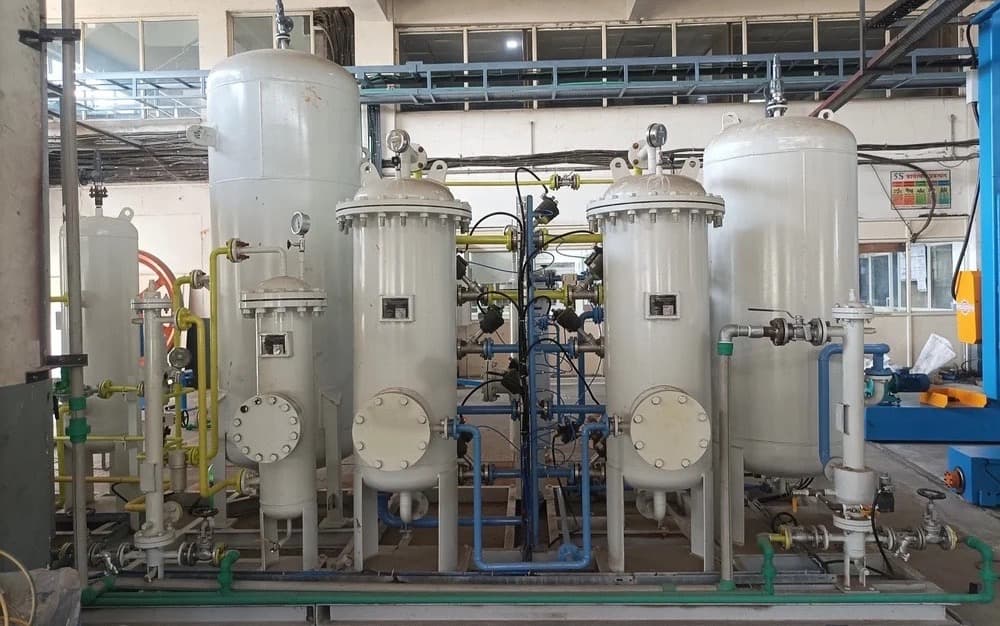
A Gastek twin-adsorber PSA plant: air receiver, two CMS beds and nitrogen buffer.
Purity
95–99.999%
Capacity
1–5,000 Nm³/h
Outlet pressure
4–7 bar(g)
Start-up
About 15 min
Two beds of CarboTech carbon molecular sieve take turns: one holds back oxygen under pressure while the other vents it, so nitrogen flows without a break. The PSA page takes the plant apart, step by step.
PSA nitrogen generator, liquid nitrogen or cylinders?
Most heat treatment shops start on cylinders or a liquid tank. Here is what changes when nitrogen is made on site.
Supply
On-site PSA
Liquid nitrogen
Cylinders
Purity
95–99.999%, set to the strictest furnace; 99.9999% with Deoxo
Very high, as delivered
The grade you buy, per cylinder
Supply
Continuous, made on site from compressed air and power
Tanker deliveries to a bulk tank, which boils off when idle
Changeovers at a manifold, by hand
Peaks
Receivers, and a booster for vacuum quenching
The vaporiser covers quench peaks
Banks of cylinders
Running cost
Mostly power for compressed air
Price per m³, tank rental, boil-off
Price per cylinder, rental, handling
Best fit in heat treatment
Shops running furnaces every day
Very large quench peaks, or as backup
A single small furnace, or occasional use
Heat treatment nitrogen FAQ
Heat treatment nitrogen generator questions
Can a PSA nitrogen generator be used for heat treatment?
Yes. PSA nitrogen runs most furnace duties: purging, nitrogen–methanol carburizing, vacuum quenching, annealing, brazing, sintering and nitriding, when purity, flow, pressure, dew point and oxygen monitoring are matched to the furnace. Bright work adds hydrogen mixing or a Deoxo purifier.
What nitrogen purity is required for heat treatment?
There is no single figure. Purges, nitriding and tempering run on 99.5–99.99%; vacuum quenching, bright annealing, brazing and sintering usually need 99.99–99.999% and dry gas. Where the furnace runs on hydrogen, oxygen in the nitrogen burns into water, so tight oxygen limits come with a Deoxo purifier.
Is nitrogen enough for bright annealing?
Not always. Bright annealing and reduction-sensitive work usually need hydrogen as well, as nitrogen–hydrogen, HNx or dissociated ammonia, with very low oxygen and a low dew point. Nitrogen is the carrier and the purge gas; the atmosphere recipe comes first.
Can PSA nitrogen replace endothermic gas?
In many sealed-quench furnaces, yes: nitrogen with cracked methanol gives an atmosphere close to endothermic gas, about 40% nitrogen, 40% hydrogen and 20% carbon monoxide, without running an endothermic generator. Carbon potential is controlled the usual way, with an oxygen probe, CO₂ or dew point.
What nitrogen do vacuum furnaces need for gas quenching?
Dry, high-purity nitrogen, usually 99.99–99.999%, delivered at the quench pressure, often several bar, within seconds. That makes the receiver and booster as important as the generator: the PSA plant refills the receiver between cycles.
How is nitrogen used in brazing?
Copper brazing of steel parts runs in nitrogen with hydrogen, so oxides reduce and the copper flows. Aluminium heat exchangers are brazed with flux in very dry nitrogen with little oxygen. In both, the atmosphere is best checked at the belt, not only at the generator.
How much nitrogen does a heat treatment furnace use?
It depends on the furnace: a sealed-quench furnace, a mesh-belt furnace and a vacuum furnace each have their own flows, door losses and purge volumes. Gastek sizes from your furnace list, meaning type, volume, atmosphere recipe, cycles and the largest purge.
How is this page different from the laser cutting nitrogen page?
This page covers furnace atmospheres. Laser cutting uses nitrogen as a high-pressure assist gas, with boosters and storage at the machine, and has its own page.
How much does a nitrogen generator for heat treatment cost in India?
The price follows the duty: flow, purity, pressure, the number of furnaces, and whether the compressor, dryer, receivers, booster, Deoxo or hydrogen mixing are in the supply. Send the furnace list and Gastek quotes a configured plant, with its running cost against your cylinders or liquid nitrogen.
What information is needed to quote a heat treatment nitrogen system?
Furnace type and volume, process temperature, material, atmosphere recipe, purity or oxygen limit, dew point, purge times, flow, pressure, operating hours, utilities, and any analyser or control requirements.
Next step
Send your use points. Get one plant sized to all of them.
List the furnaces and what each needs. Gastek replies with a nitrogen plant, and the hydrogen mixing, Deoxo or booster the furnaces need, sized to the strictest furnace and the largest purge.
Gastek contact hoursMon–Sat, 9:00 am–6:00 pm IST
Furnaces: type, volume and number
Atmosphere recipe for each: nitrogen, hydrogen, methanol, ammonia