
Membrane Nitrogen Generators
Gastek manufactures membrane nitrogen generators in India using hollow-fibre air separation. Compact, silent skids deliver 95–99.5% nitrogen at the use point — the practical route where moderate purity, instant start-up, and minimal maintenance matter more than the last decimal of purity.
System basis
Hollow-fibre membrane separation
Nitrogen purity
95–99.5%
Purity is set around the application; higher-purity duties are routed to PSA or PSA + Deoxo systems
Capacity
Up to 5000 Nm³/hr
Membrane banks are sized to flow, duty cycle, and available compressed air
Outlet pressure
Up to 13 bar(g)
Delivered dry at a dew point of -40°C, ready for blanketing, packaging, and inerting duties
Best fit: moderate-purity nitrogen duties where footprint, start-up speed, and simplicity beat the alternatives — and where cylinder or liquid nitrogen dependence is costly.
Replace
Cut dependence on cylinder logistics and liquid nitrogen contracts with nitrogen generated at the use point.
Start instantly
Membrane separation begins as soon as compressed air flows. No warm-up period, no adsorber cycling.
Run simply
No moving parts in the separation stage means silent operation and minimal routine maintenance.
Fit anywhere
Skid-mounted packages with a small footprint suit congested utility rooms and containerized installations.
Working principle
How hollow-fibre membranes separate nitrogen from air
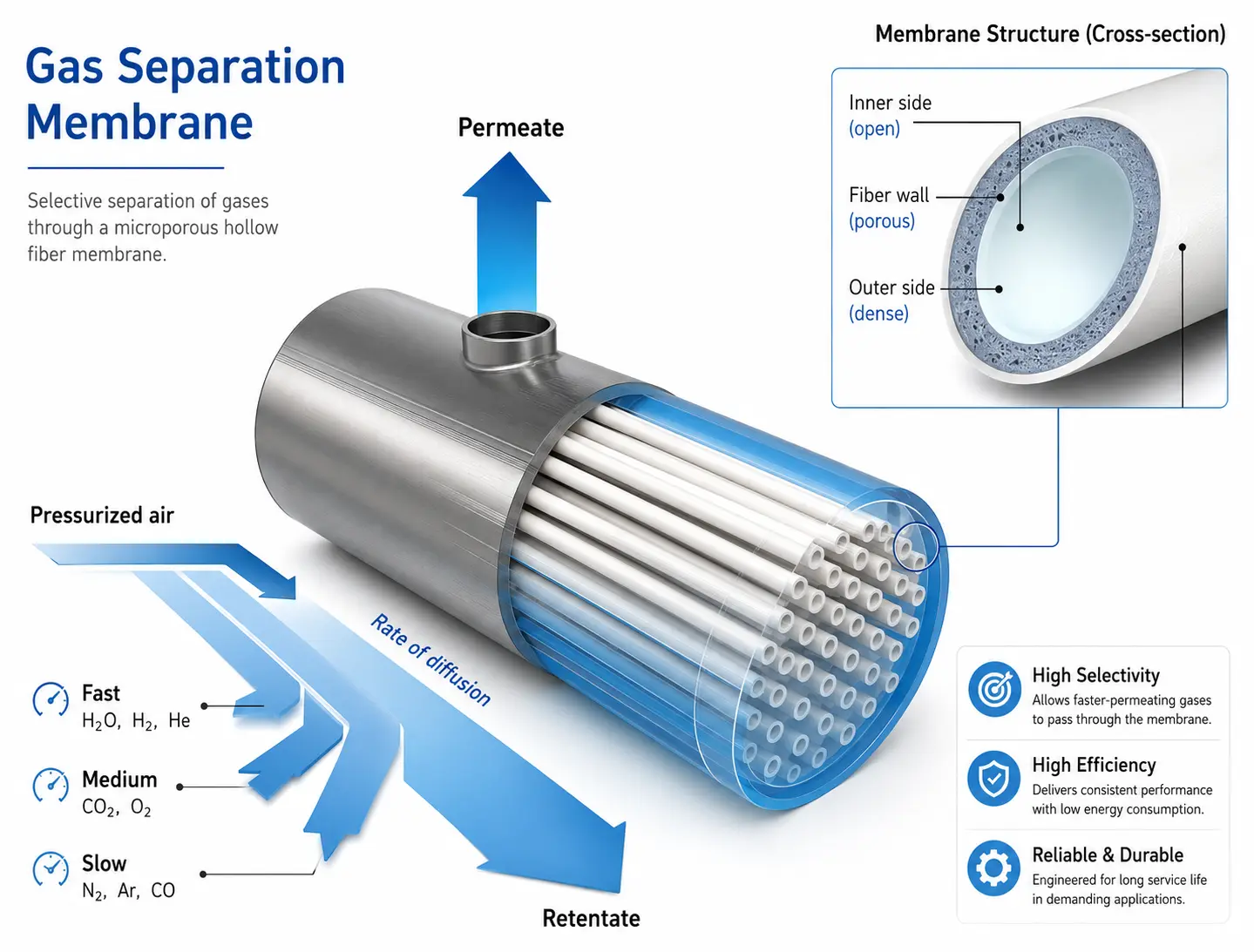
Every gas permeates a polymer membrane at a different rate. Oxygen, water vapour, and CO₂ pass through the fibre walls quickly; nitrogen passes slowly. Flow compressed air through thousands of hollow fibres and what comes out the far end is dry, moderate-purity nitrogen — continuously, with nothing to switch, regenerate, or cycle.
Compressed air treatment
Compressed air is filtered to remove oil, water droplets, and particulates before it reaches the membrane bank. Feed air quality is the main factor in membrane life, so the filtration train is engineered as part of the package.
Selective permeation
The treated air flows through bundles of hollow fibres. Oxygen, water vapour, and CO₂ permeate the fibre walls faster than nitrogen and are vented to atmosphere as an oxygen-enriched permeate stream.
Nitrogen delivery
The slower-permeating nitrogen continues along the fibres and leaves the module as dry product gas at pressure. Purity is tuned by adjusting flow and operating conditions, so one system can serve different duty points.
Technical scope
Membrane nitrogen generator specifications
Each package is engineered around the actual duty rather than a catalogue model. Purity, flow, pressure, dew point, and compressed air quality are confirmed before the membrane bank and filtration train are sized.
Manufactured in India by Gastek Engineering — gas generation systems since 1993.
Technology selection
Membrane vs PSA nitrogen generation
Gastek manufactures both technologies, so the recommendation follows the duty — not a product line. The deciding questions are purity, flow, duty cycle, and lifecycle cost.
Membrane — choose when:
Nitrogen purity of 95–99.5% suits the application
Installation space is limited or the site is remote
Immediate start-up and stop-start operation are required
Minimal maintenance and simple operation are priorities
Silent operation matters — no cycling valves or bed switching
PSA — choose when:
High-purity nitrogen (up to 99.999%) is required
Large, continuous flow rates are needed
Energy cost per Nm³ at higher purity is a priority
Consistent purity across long production runs is essential
Lifecycle operating cost outweighs footprint considerations
Not sure which route fits? The interactive guide walks through supply method, purity, operating hours, and installation environment.
Nitrogen Selection GuideApplications
Where membrane nitrogen is specified
Membrane systems suit duties where 95–99.5% nitrogen purity is enough and the buyer values a simple, compact machine over the last increment of purity.
Food Packaging & Beverage
Modified atmosphere packaging to extend shelf life, plus blanketing and transfer duties in wine, juice, and edible oil production where oxygen causes spoilage.
Electronics & Soldering
Nitrogen atmospheres for soldering processes and protection of oxidation-sensitive components during manufacturing and storage.
Oil, Gas & Chemicals
Tank and pipeline blanketing, purging, and inerting duties where a compact, low-maintenance nitrogen source is preferred over delivered gas.
Fire Prevention & Inerting
Nitrogen inerting systems that lower oxygen concentration in enclosed spaces, storage areas, and archives to prevent combustion.
Tire Inflation
Dry nitrogen for tire inflation in automotive, fleet, and aviation service — stable pressure and reduced oxidation of liner and rim.
Pharmaceuticals
Blanketing and packaging applications in pharmaceutical manufacturing where moderate-purity dry nitrogen is sufficient for the duty.
Export markets
Exporting membrane nitrogen generators worldwide
Gastek ships membrane nitrogen systems from India to industrial buyers across the Middle East, Africa, and Asia — with sizing support before order, export packing and documentation, and installation and startup support at the destination.
Middle East
Membrane nitrogen systems for food packaging, electronics, oil & gas, and manufacturing across the Gulf, shipped through Jebel Ali, Dammam, and Hamad Port with installation support in major cities.
Contact for Middle EastAfrica
Nitrogen packages for food & beverage, manufacturing, and fire prevention duties, shipped to Alexandria, Durban, Lagos, and other major ports with commissioning support.
Contact for AfricaSouth & Southeast Asia
Fast delivery from India for electronics, food packaging, and industrial buyers across the region, with English-language technical support through sizing, dispatch, and startup.
Contact for South & Southeast AsiaBuying from another region? Gastek also exports membrane nitrogen systems to Europe, South America, and other global markets — enquire for your country.
Questions buyers ask before specifying a membrane nitrogen generator
What purity can a membrane nitrogen generator achieve?
Membrane nitrogen generators typically deliver 95% to 99.5% nitrogen purity. The purity is selected around the application: lower purity gives more flow from the same membrane area, while higher purity reduces output. If the process needs purity beyond 99.5%, a PSA nitrogen generator or a PSA plant with a Deoxo purifier is usually the better route.
Should I choose a membrane or PSA nitrogen generator?
Choose membrane when 95–99.5% purity suits the duty and instant start-up, compact footprint, silent operation, and minimal maintenance matter. Choose PSA when the process needs higher purity (up to 99.999%), larger continuous flows, or the lowest energy cost per Nm³ at high purity. Gastek manufactures both, so the recommendation is based on the duty rather than a single product line.
What does a membrane nitrogen generator need to operate?
The system needs a supply of filtered compressed air and a small amount of power for instrumentation and controls. Feed air quality is the most important factor: oil, water, and particulates must be removed before the membrane bank, so the filtration train is engineered as part of the package. An existing plant air compressor can often be used if its capacity and air quality are suitable.
How much maintenance does a membrane nitrogen system require?
Routine maintenance is limited mainly to filter element changes and periodic checks of instrumentation, because the separation stage has no moving parts, switching valves, or adsorbent beds. Membrane module life depends primarily on feed air quality, which is why the air treatment train is specified together with the membrane bank.
Can a membrane nitrogen generator replace cylinders or liquid nitrogen?
Yes, where the required purity and flow fall within the membrane operating range. On-site generation removes ordering cycles, delivery dependence, rental charges, and handling of high-pressure cylinders or cryogenic liquid. The comparison should include gas cost, operating hours, compressed air cost, and backup philosophy, which Gastek can review as part of sizing.
How is the right membrane system size selected?
Sizing starts from required flow, purity, and use-point pressure, then covers duty cycle, operating hours, dew point, ambient conditions, and the available compressed air supply. From these inputs Gastek selects the membrane bank, filtration train, and controls, and confirms whether an existing compressor can feed the system or a dedicated one is needed.
Does Gastek export membrane nitrogen generators?
Yes. Gastek exports membrane nitrogen generators from India to the Middle East, Africa, and South and Southeast Asia, with dedicated support for buyers in the UAE, Saudi Arabia, Qatar, Oman, Kuwait, Bahrain, Egypt, and Bangladesh. Export scope covers sizing, packing, documentation, shipping to major ports, and installation and startup support.
What information is needed for a membrane nitrogen quotation?
Useful inputs include required nitrogen flow, target purity, outlet pressure, operating hours, application, existing compressed air details if any, installation location, and destination country for export projects. With these, Gastek can propose the membrane package or recommend a PSA route if that fits the duty better.
Next step
Share your nitrogen requirement and get a membrane system sized to the duty.
Tell us the flow, purity, pressure, operating hours, application, and installation location. Gastek will review whether a membrane package fits — or recommend a PSA route if that serves the duty better.
Required nitrogen flow rate and peak demand
Target nitrogen purity for the application
Use-point pressure and pressure drop
Operating hours and duty cycle