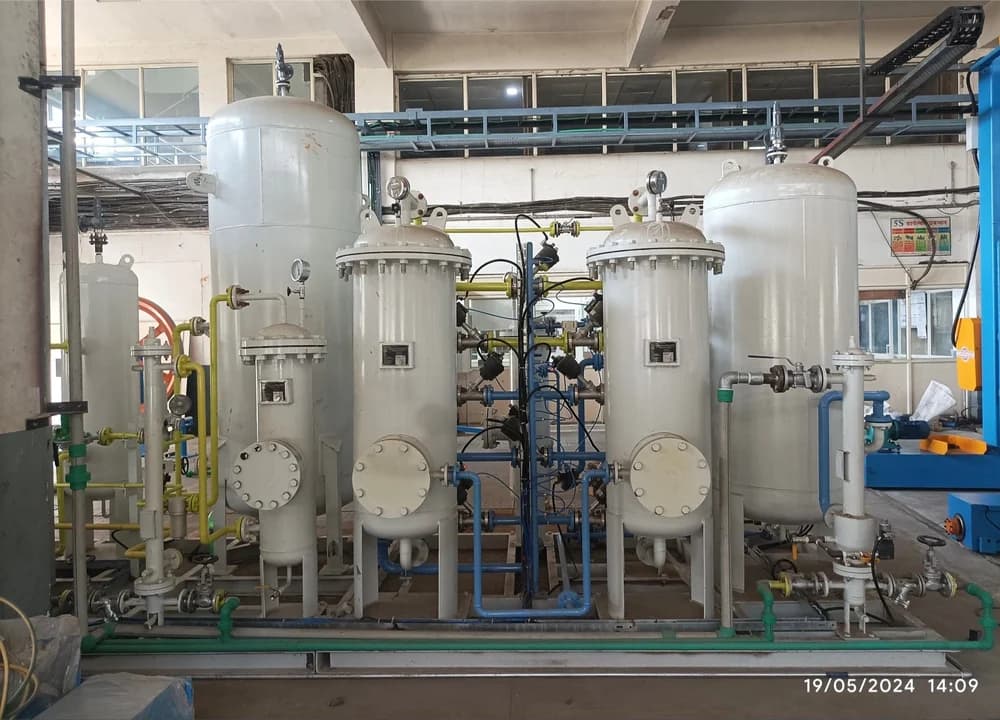
What purity can a PSA nitrogen generator achieve?
Gastek PSA nitrogen generators deliver 95% to 99.999% nitrogen purity, selected around the application. Standard duties like blanketing and food packaging typically run at 97.5–99.9%, while electronics and pharmaceutical processes use up to 99.999%. Where ppm-level residual oxygen is required — up to 99.9999% purity — a Deoxo purifier is added downstream of the PSA plant.
How does a PSA nitrogen generator work?
PSA stands for pressure swing adsorption. Filtered, dried compressed air flows through a vessel packed with carbon molecular sieve (CMS), which traps oxygen, CO₂, and moisture in its micropores while nitrogen passes through as product gas. Twin adsorber vessels alternate automatically: while one produces nitrogen at pressure, the other regenerates by venting the adsorbed oxygen to atmosphere. The cycle repeats continuously, so nitrogen supply never stops.
What capacity range does Gastek manufacture?
Standard PSA nitrogen plants cover 1 to 5000 Nm³/hr, with higher capacities engineered on request. Each plant is sized from the actual duty — flow, purity, use-point pressure, duty cycle, and operating hours — rather than picked from a fixed catalogue, so the compressor, CMS volume, and buffer capacity match the real demand profile.
Is on-site PSA nitrogen cheaper than cylinders or liquid nitrogen?
In most continuous-use cases, yes — generating nitrogen on-site typically costs a fraction of delivered cylinder or liquid nitrogen once operating hours are meaningful. The main operating cost is compressed air, so the economics depend on gas price, power cost, and utilization. On-site generation also removes ordering cycles, rental charges, delivery dependence, and handling of high-pressure cylinders. Gastek reviews the payback as part of sizing.
Should I choose a PSA or membrane nitrogen generator?
Choose PSA when the process needs higher purity (up to 99.999%), larger continuous flows, or the lowest energy cost per Nm³ at high purity. Choose membrane when 95–99.5% purity suits the duty and instant start-up, compact footprint, and minimal maintenance matter most. Gastek manufactures both technologies, so the recommendation follows the duty rather than a product line.
What does a PSA nitrogen plant need to operate?
The plant needs a supply of compressed air and electrical power for the controls and analyzer. The air treatment train — filtration and drying — is engineered as part of the package because feed air quality determines CMS bed life. An existing plant air compressor can often be used if its capacity and air quality are suitable; otherwise a dedicated compressor is specified with the plant.
How quickly does a PSA plant start up, and can it run unattended?
A Gastek PSA nitrogen generator reaches on-spec purity in approximately 15 minutes from cold start. Operation is fully automatic: PLC control with a touch-screen HMI manages the adsorption cycle, and a continuous online oxygen analyzer monitors product purity, so the plant runs unattended as a utility.
Does Gastek export PSA nitrogen generators?
Yes. Gastek exports PSA nitrogen generators from India to the Middle East, Southeast Asia, and Africa, with dedicated support for buyers in the UAE, Saudi Arabia, Qatar, Oman, Kuwait, Bahrain, Malaysia, Thailand, Indonesia, Vietnam, Egypt, Kenya, and more, plus Turkey, Bangladesh, and Sri Lanka. Export scope covers sizing, packing, documentation, shipping to major ports, and commissioning support.
What information is needed for a PSA nitrogen generator quotation?
Useful inputs are required nitrogen flow, target purity or residual O₂ specification, use-point pressure, application, operating hours, and installation location — plus destination country for export projects. With these, Gastek proposes the right PSA configuration instead of a generic plant quote, or recommends a membrane route if that fits the duty better.