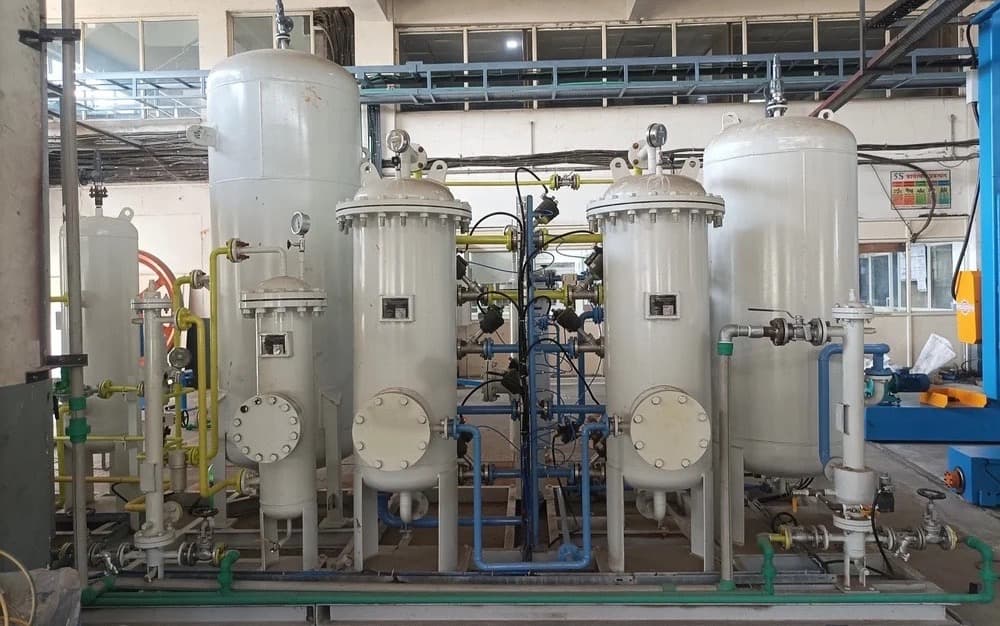
Nitrogen generators for steel plants and processing lines
Steel customers of Gastek
Gastek PSA nitrogen plants supply steel plants at 95–99.999% purity for galvanizing and annealing atmospheres, coal injection, the blast furnace top and purging, with HNx mixing and Deoxo where a line needs them. Made in India since 1993, for steel companies in India, Egypt, Iran and North America.
Tap a number or a machine. Scroll the drawing sideways.
CGL atmosphere plants
Complete protective gas plants supplied for continuous galvanizing lines
Egypt, Iran, North America
PSA nitrogen and ammonia cracker units for steel companies abroad
Since 1993
Nitrogen plants designed and built in India
99.999%
With CarboTech carbon molecular sieves; ppm-level O₂ with Deoxo
Use points
Uses of nitrogen in the steel industry
Six places nitrogen does a job in a steel plant, from the blast furnace top to the zinc pot. Lines that need a reducing atmosphere take hydrogen with it, mixed on site.
Use point 1 · HNx furnace atmosphere and snout seal
Galvanizing lines (CGL)
The annealing furnace runs on nitrogen with a few percent hydrogen, so the strip reaches the zinc pot free of oxide. The snout takes nitrogen too, and so do the air knives on some lines.
Typical purity
99.99–99.999%
Sized from
Furnace volume, line speed, H₂ share, dew point
Use point 2 · Purges before and after hydrogen
Bell annealing furnaces
Cold-rolled coils anneal under a protective cover. Nitrogen purges the air out before hydrogen or HNx goes in, and purges the hydrogen out again before the cover lifts.
Typical purity
99.9–99.999%
Sized from
Bases in cycle, cover volume, purge time
Use point 3 · Bright annealing atmospheres
Tube, wire and strip annealing
Continuous furnaces for stainless tube, wire and strip run on nitrogen–hydrogen or dissociated ammonia, so the product comes out bright and needs no pickling.
Typical purity
99.99–99.999%
Sized from
Furnace section, throughput, H₂ share
Use point 4 · Inerting and pressurising
Pulverised coal injection
Nitrogen keeps oxygen out of the coal mill's bag filter and the injection vessels, where fine coal and air would burn, pressurises the vessels and often conveys the coal to the tuyeres.
Typical purity
97–99.5%
Sized from
Vessel cycles, conveying rate, mill size
Use point 5 · Top seal, cooling and equalising
Blast furnace top
On a bell-less top, nitrogen seals and cools the charging gear and helps equalise the hoppers, so burden drops in without letting furnace gas out.
Typical purity
97–99.5%
Sized from
Charging cycle, hopper volume, seal flow
Use point 6 · Purging before and after maintenance
Gas lines and holders
Blast furnace, coke oven and converter gas lines and holders are purged with nitrogen before they are opened and again before gas goes back in. These purges often set the plant's peak flow.
Typical purity
95–99.5%
Sized from
Line volume, target O₂ or CO, time allowed
Purity
What purity of nitrogen does a steel plant need?
From 97% for coal injection to 99.999% and better for galvanizing furnaces. Where a furnace runs on hydrogen, every 0.1% of oxygen in the nitrogen burns into about 0.2% water vapour and raises the dew point. Drawn in nines, so each step to the right leaves ten times less oxygen.
Nitrogen purity, %
959999.999.9999.99999.9999
Use points, typical
1 · Galvanizing lines (CGL)
HNx furnace atmosphere and snout seal
99.99–99.999%
2 · Bell annealing furnaces
Purges before and after hydrogen
99.9–99.999%
3 · Tube, wire and strip annealing
Bright annealing atmospheres
99.99–99.999%
4 · Pulverised coal injection
Inerting and pressurising
97–99.5%
5 · Blast furnace top
Top seal, cooling and equalising
97–99.5%
6 · Gas lines and holders
Purging before and after maintenance
95–99.5%
Gastek PSA plant
PSA nitrogen generator
Set to the strictest use point
95–99.999%
With a Deoxo purifier
ppm-level oxygen after the PSA plant
to 99.9999%
The furnace maker writes the nitrogen's oxygen and dew point into each line's specification, and Gastek sizes to it. Typical use-point ranges, to confirm against your lines.
Atmospheres
Nitrogen, HNx or Deoxo: what each line takes
The gas in each furnace, and the Gastek plant that makes it on site. Hydrogen comes from an ammonia cracker, an electrolyser or cylinders.
Line
Gas in the furnace
Nitrogen quality
Gastek supply
Galvanizing (CGL)
Nitrogen with 2–10% hydrogen (HNx)
99.999% or better, very dry
PSA nitrogen, Deoxo and HNx mixing, with hydrogen from a cracker or electrolyser
Bell annealing
Hydrogen or HNx, with nitrogen purges
99.9–99.999%
PSA nitrogen; HNx mixing where the furnace runs on it
Tube and wire annealing
Nitrogen–hydrogen, or dissociated ammonia (75% H₂, 25% N₂)
99.99–99.999%
PSA nitrogen with HNx mixing, or an ammonia cracker
Coal injection, furnace top
Nitrogen only
97–99.5%
PSA nitrogen at the header pressure the system needs
Purging
Nitrogen only
95–99.5%
PSA nitrogen, with receivers sized for the purge
Uptime
Uptime, monitoring and documents
A line that stops for gas loses a shift. What the plant does to keep running, what comes with it, and what your team decides.
Built into the plant
Online oxygen analyser, with alarms and off-spec venting
Dew point monitoring where the line sets a dryness limit
Receivers sized for purges and line starts
A standby compressor, or two PSA trains, where the line can't stop
Hydrogen mixing and Deoxo with their own analysers, where fitted
PLC with touch-screen HMI; fully automatic, unattended
Supplied with it
Factory acceptance test (FAT) records
P&ID, general arrangement and wiring drawings
Operating and maintenance manuals
Calibration certificates for the analysers and instruments
Commissioning data and report
A maintenance plan for filters, dryer and CMS
Decided by your team
Gas recipe, oxygen and dew point for each line
Backup: a liquid nitrogen tank, a standby train, or both
Hydrogen safety: interlocks, area classification and venting
Purge procedures before maintenance and restart
Line boundary
Gastek supplies the gas at the specified quality, pressure and flow, with the analysers that prove it. The furnace's atmosphere control, interlocks and purge procedures belong to the line maker and your plant team.
The plant
The PSA nitrogen plant behind it
The same Gastek plant feeds every use point, sized from 1 to 5,000 Nm³/h.
A Gastek twin-adsorber PSA plant: air receiver, two CMS beds and nitrogen buffer.
Purity
95–99.999%
Capacity
1–5,000 Nm³/h
Outlet pressure
4–7 bar(g)
Start-up
About 15 min
Two beds of CarboTech carbon molecular sieve take turns: one holds back oxygen under pressure while the other vents it, so nitrogen flows without a break. The PSA page takes the plant apart, step by step.
PSA nitrogen, liquid nitrogen or an air separation plant?
Integrated plants often run an air separation unit for oxygen. Processing lines, galvanizing lines and plants without one usually choose between PSA and liquid.
Supply
On-site PSA
Liquid nitrogen
Cryogenic air separation
Purity
95–99.999%, set to the strictest line; 99.9999% with Deoxo
Very high, as delivered
Very high
Scale
1–5,000 Nm³/h per plant; trains can be added
Limited by deliveries and tank size
Thousands of Nm³/h, usually alongside oxygen
Start-up
About 15 minutes
Immediate, from the tank
Hours after a stop
Running cost
Mostly power for compressed air
Price per m³, tank rental, boil-off
Power and maintenance; best at full load
Best fit in steel
Processing and galvanizing lines, coal injection and purges near the use point
Backup, and short peaks
Integrated plants that also need oxygen in bulk
Steel nitrogen FAQ
Steel plant nitrogen generator questions
Is PSA nitrogen suitable for steel plants?
Yes, for most steel plant duties: galvanizing and annealing atmospheres, coal injection, the blast furnace top and purging. The plant is sized to each line's purity, flow, pressure and dew point, and lines that need a reducing atmosphere add HNx mixing, an ammonia cracker or a Deoxo purifier.
What nitrogen purity does a galvanizing line need?
Galvanizing furnaces run on nitrogen with 2–10% hydrogen, and the nitrogen itself is usually specified at 99.999% or better and very dry. Oxygen in the nitrogen burns hydrogen into water and oxidises the strip before it reaches the zinc. A PSA plant with a Deoxo purifier meets that; the line maker's specification sets the final figure.
What is HNx gas?
HNx is nitrogen with a few percent of hydrogen, typically 2–10%, used as a protective, slightly reducing atmosphere in annealing and galvanizing furnaces. Gastek makes it on site by mixing PSA nitrogen with hydrogen from an ammonia cracker, an electrolyser or cylinders.
Why does oxygen in nitrogen matter in a hydrogen furnace?
Oxygen in the nitrogen reacts with the hydrogen to form water vapour: every 0.1% of oxygen becomes about 0.2% water, which raises the furnace dew point and oxidises the steel. That is why furnace nitrogen is specified in ppm of oxygen, and why Gastek adds a Deoxo purifier when PSA purity alone is not enough.
Is nitrogen alone enough for bright annealing?
Not always. Bright annealing and reduction-sensitive steel processes usually need hydrogen as well, as HNx, dissociated ammonia or pure hydrogen, with very low oxygen and a low dew point. Nitrogen is the carrier and the purge gas; the line's atmosphere recipe comes first.
How much nitrogen does a steel plant use?
There is no typical figure: a galvanizing line, a bell annealing shop and a coal injection system each set their own flow, and purges add short peaks. Gastek sizes from the line data, meaning furnace volumes, line speed, hydrogen share and the purge schedule, and adds receivers for the peaks.
Can one nitrogen generator supply several steel plant lines?
Yes. One central PSA plant can supply several lines if it is sized for peak simultaneous demand, purge events, receiver storage, pressure control and future expansion. Lines that need different purities can share a header, with a Deoxo stage only on the line that needs it.
PSA nitrogen or an air separation unit for a steel plant?
An air separation unit makes sense when the plant also needs oxygen in bulk, as integrated plants with blast furnaces and converters do. For a processing complex, a galvanizing line or a plant without an oxygen demand, PSA nitrogen is usually cheaper to own, starts in about 15 minutes and can sit next to the line. Many integrated plants run both.
How much does a nitrogen plant for a steel plant cost in India?
The price follows the duty: flow, purity, delivery pressure, the number of lines, redundancy, and whether the compressors, dryers, receivers, Deoxo and HNx mixing are in the supply. Send the lines and Gastek quotes a configured plant, with its running cost against liquid nitrogen.
What information is needed to quote a steel nitrogen system?
The line or furnace type, material, gas recipe, oxygen and dew point limits, flow, pressure, purge times, operating hours, simultaneous users, available utilities, and the controls and documents you need.
Next step
Send your use points. Get one plant sized to all of them.
List the lines and what each needs. Gastek replies with a nitrogen plant, and the hydrogen and Deoxo stages if the furnaces need them, sized to the strictest line and the largest purge.