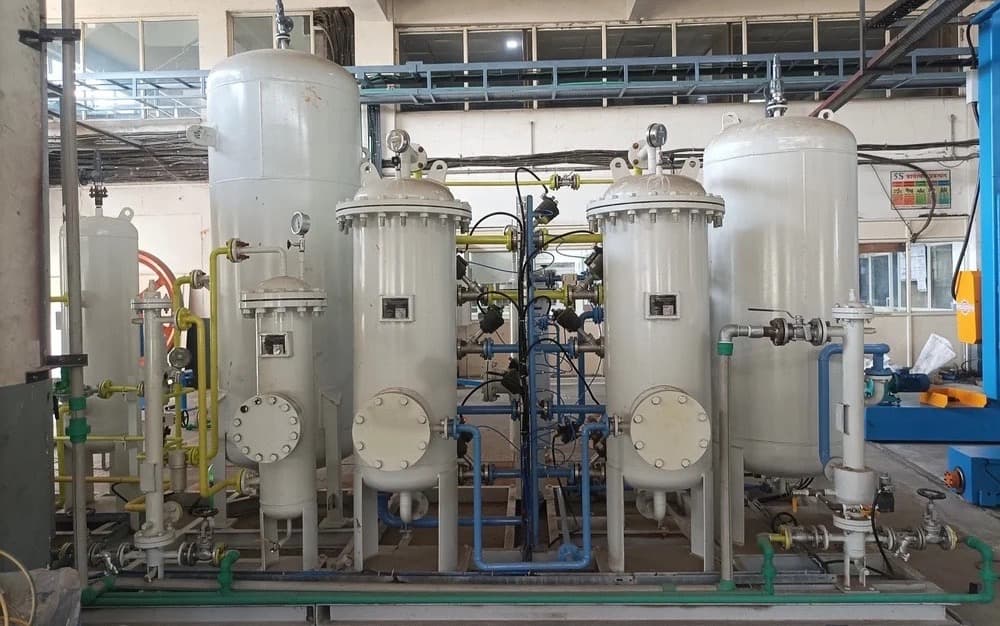
Gastek PSA nitrogen plants, finished with Deoxo and drying, make high-purity nitrogen on site for solar cell lines: diffusion and LPCVD furnaces, PECVD and ALD tools, wet benches and wafer storage, at up to 99.9999% purity. Made in India since 1993, in plants of up to 2,500 Nm³/hr.
Tap a number or a machine. Scroll the drawing sideways.
Up to 99.9999%
PSA nitrogen with Deoxo, drying and filtration
Up to 2,500 Nm³/hr
A single Gastek PSA plant, built for GSFC
Since 1993
Nitrogen plants designed and built in India
D-U-N-S 91-686-7372
ISO 9001:2015 quality management
Use points
Uses of nitrogen in solar cell manufacturing
Six places nitrogen does a job on a PERC, TOPCon or heterojunction line. The furnaces and deposition tools set the purity; wet benches, storage and exhaust add much of the flow.
Use point 1 · Carrier gas and tube purging
Diffusion furnaces
Nitrogen carries the phosphorus or boron source into the quartz tubes, purges them between boats and fills them while they idle. Oxygen or moisture here shows up as defects in the junction.
Typical purity
99.999% and up
Sized from
Tube count, purge recipe, idle flow
Use point 2 · Venting, purging and annealing
LPCVD and annealing
TOPCon's tunnel oxide and polysilicon layers grow in low-pressure furnaces that vent and purge with nitrogen, then anneal under it to activate the doped polysilicon.
Typical purity
99.999% and up
Sized from
Tube count, vent and purge cycles
Use point 3 · Load-lock venting and purging
PECVD and ALD
Silicon nitride and aluminium oxide passivation tools vent their load locks with nitrogen and purge between process gases, so no air or moisture reaches the wafers.
Typical purity
99.999% and up
Sized from
Tool count, vent cycles, purge flows
Use point 4 · Drying, bubbling and blanketing
Wet benches and dryers
Texturing and cleaning benches dry wafers with hot nitrogen, bubble it through baths and blanket chemical tanks.
Typical purity
99.99–99.999%
Sized from
Bench count, dryer flow, bath count
Use point 5 · Dry, low-oxygen storage
Wafer storage and automation
Wafers wait between steps in nitrogen-purged cabinets and stockers, so cleaned and passivated surfaces don't pick up oxide or moisture.
Typical purity
99.99–99.999%
Sized from
Cabinet count, purge flow per cabinet
Use point 6 · Purging and silane dilution
Gas cabinets and exhaust
Gas cabinets purge their lines with nitrogen before and after cylinder changes, and exhaust from silane and other process gases is diluted with nitrogen on its way to the scrubber.
Typical purity
99.9–99.999%
Sized from
Cabinet count, dilution ratio, scrubber flow
Purity
What purity of nitrogen does a solar cell line need?
Process tools ask for 99.999% and better, with oxygen and moisture counted in ppm; utilities can take less. Drawn in nines, so each step to the right leaves ten times less oxygen.
Nitrogen purity, %
959999.999.9999.99999.9999
Use points, typical
1 · Diffusion furnaces
Carrier gas and tube purging
99.999% and up
2 · LPCVD and annealing
Venting, purging and annealing
99.999% and up
3 · PECVD and ALD
Load-lock venting and purging
99.999% and up
4 · Wet benches and dryers
Drying, bubbling and blanketing
99.99–99.999%
5 · Wafer storage and automation
Dry, low-oxygen storage
99.99–99.999%
6 · Gas cabinets and exhaust
Purging and silane dilution
99.9–99.999%
Gastek PSA plant
PSA nitrogen generator
Set to the strictest use point
95–99.999%
With a Deoxo purifier
ppm-level oxygen after the PSA plant
to 99.9999%
Tool makers set the purity, oxygen, moisture and particle limits at each tool inlet, and many fit point-of-use purifiers as well. Typical ranges, to confirm against your tool list.
Gas quality
Gas quality, monitoring and documents
What the plant does on its own, what comes with it, and what your facilities team decides.
Built into the plant
Online oxygen analyser reading in ppm, with alarms and off-spec venting
Dew point analyser after the dryer
Deoxo purifier: palladium, or copper where no hydrogen may remain
Particle filtration at the plant outlet
Receivers sized for vent and purge peaks
PLC with touch-screen HMI; fully automatic, unattended
Supplied with it
Factory acceptance test (FAT) records
P&ID, general arrangement and wiring drawings
Operating and maintenance manuals
Calibration certificates for the analysers and instruments
Commissioning data and report
A maintenance plan for filters, dryer and CMS
Decided by your facilities team
Purity, oxygen, moisture and particle limits at each tool
Point-of-use purifiers, and where they go
Backup: a liquid tank, a second train, or both
Distribution: stainless piping, cleaning and testing
Purity boundary
Gastek states purity, oxygen and dew point at the plant outlet. What reaches each tool also depends on the distribution piping and any point-of-use purifiers, which your facilities team specifies.
The plant
The PSA nitrogen plant behind it
The same Gastek plant feeds every use point, sized from 1 to 5,000 Nm³/hr.
A Gastek twin-adsorber PSA plant: air receiver, two CMS beds and nitrogen buffer.
Purity
95–99.999%
Capacity
1–5,000 Nm³/hr
Outlet pressure
4–7 bar(g)
Start-up
About 15 min
Two beds of CarboTech carbon molecular sieve take turns: one holds back oxygen under pressure while the other vents it, so nitrogen flows without a break. The PSA page takes the plant apart, step by step.
On-site PSA, liquid nitrogen or an air separation plant?
Large cell campuses often sign for an air separation plant or a pipeline. A line of a few GW, an expansion, or a second source beside liquid is where on-site PSA with Deoxo fits.
Supply
On-site PSA with Deoxo
Liquid nitrogen
Air separation plant
Purity
To 99.9999%, oxygen and moisture in ppm
Very high, as delivered
Very high
Scale
1–5,000 Nm³/hr per plant; trains added as lines are added
Limited by tanker deliveries and tank size
Thousands of Nm³/hr; economic at very large scale
Start-up
About 15 minutes
Immediate, from the tank
Hours after a stop
Running cost
Mostly power for compressed air, plus a little hydrogen for the Deoxo
Price per m³, tank rental, boil-off
Power and maintenance, or a long-term supply contract
Best fit in solar
A line of a few GW, an expansion, or a second source
Backup, and the months before an on-site plant runs
Very large campuses, usually under a supply contract
Solar cell nitrogen FAQ
Solar cell nitrogen generator questions
Can PSA nitrogen be used in solar cell manufacturing?
Yes, with the right finishing. A PSA plant makes the base nitrogen; a Deoxo purifier takes oxygen down to ppm level and a dryer removes the water it forms, giving up to 99.9999% purity. Tool makers set the limits at each tool inlet, and many add point-of-use purifiers.
What purity of nitrogen do diffusion and LPCVD furnaces need?
99.999% and better, with oxygen and moisture held to a few ppm or less at the tool inlet, because both grow oxide where it is not wanted. Your tool maker's facility specification gives the exact limits, and Gastek sizes the Deoxo and dryer to them.
How much nitrogen does a solar cell plant use?
It depends on the cell technology and the tool list. One published Indian contract supplies 2,400 Nm³/hr to a 4.5 GW TOPCon plant, a little over 500 Nm³/hr per GW. Gastek sizes from your tool list, vent and purge cycles, and the expansion you plan.
Which solar cell technologies use nitrogen?
All of them. PERC, TOPCon and heterojunction lines use nitrogen for purging, venting, carrier gas, drying and storage. TOPCon adds boron diffusion and polysilicon deposition steps, and heterojunction lines keep wafers under nitrogen between cleaning and deposition.
Palladium or copper Deoxo for solar cell nitrogen?
Palladium Deoxo removes oxygen with a small excess of hydrogen, so a trace of hydrogen stays in the nitrogen. Copper Deoxo leaves none, and suits tools that must not see hydrogen. Both need a dryer after them to take out the water they form.
Is on-site nitrogen cheaper than liquid nitrogen for a cell line?
For continuous use, usually. A PSA plant's main running cost is power for compressed air, with a little hydrogen for the Deoxo, while liquid nitrogen carries the gas price, tank rental and boil-off. Gastek works out the comparison from your flow and power tariff.
Can a PSA plant back up an air separation plant or a liquid tank?
Yes. A PSA plant beside an existing supply can carry part of the load all the time, or take over when deliveries or the air separation plant stop. Purity, pressure and the changeover are designed with your facilities team.
Does ALMM List-II change nitrogen demand in India?
Since 1 June 2026, projects covered by the ALMM order must use solar cells from India's approved list, which held about 37.8 GW of cell capacity by October 2026. Every new cell line needs high-purity nitrogen, so demand grows with each line built.
How much does a nitrogen plant for a solar cell factory cost in India?
The price follows the duty: flow, purity, oxygen and dew point at the outlet, Deoxo type, redundancy, and whether the compressors, dryers and receivers are in the supply. Send your tool list and Gastek quotes a configured plant, with its running cost against liquid nitrogen.
What maintenance does a solar cell nitrogen plant need?
Most of it is on the air side: filters, drains and dryers, plus calibrating the oxygen and dew point analysers. The CMS and Deoxo catalyst last for years when the feed air is clean, and Gastek supplies CarboTech CMS for refills.
Next step
Send your use points. Get one plant sized to all of them.
List the tools and what each needs. Gastek replies with a PSA plant, Deoxo and dryer sized to the strictest tool and the largest vent cycle, with the outlet purity stated in the offer.